Still chuckling about this:
Monthly Archives: June 2007
Education Democratically
To me the read/write web displays the best (and worst!) of the true meaning of democracy. People vote with their keyboards on what is the best/worst, hot/not, good/bad.
A couple of good things have happened recently. One, a middle school student from Falls Church entered a video contest on C-Span that not only one him a prize, but improved upon a situation that needed to recieve attention.
The 13-year old Wilson of Luther Jackson Middle School won first prize among middle school entries in “StudentCam,†C-SPAN’s National Video Documentary Contest for his documentary “When the Boys Come Home: The Controversy at Walter Reed.†Wilson took home $1,000 in prize money, and his video will be played at 6:50 a.m. on C-SPAN on June 14.
Wilson’s video, which runs just under 10 minutes long, highlights the controversy surrounding the cleanliness and medical care provided at Walter Reed Hospital, which takes care of wounded American soldiers returning from battle. Wilson relates the issue to his own family, as his brother Sgt. Gordon “Gordy†Hamm is currently serving in Iraq.
“What would happen to my brother should he be injured in Iraq?†Wilson asks during the narration of his documentary.
You can see him on Fox News and others or read the article in the Falls Church newspaper here. You don’t have to be a big Hollywood producer to get your story out there anymore!
Another great thing is a new section that has been added to the iTunes store called iTunes U. You can read more about it on the Apple website but basically what it entails is different universities have some of their classes on podcast and videocast and you can subscribe. Now you can go to M.I.T. and Berkeley and never leave your living room!
Science is Disgusting
Actually “disgusting” is now a science. There has been research on how we associate “cooties” with certain things. For example, if you have a grocery cart full of items and the chocolate chip cookies end up next to the toilet bowl cleaner the cookies end up somehow less appealing to us due to their proximity to the thing we think is gross. It’s kind of like the old saw about laying down with dogs and getting up with fleas. They are using this research to rethink how items are arranged in a grocery store. In the past you would have one aisle for all the baby stuff – from diapers to formula. According to this research the baby food items would be more appealing if the diapers were elsewhere.
As someone who has had to go to the grocery store with babies I have to take issue with this thinking. If I have a toddler in the cart chewing on the package of cheese that I’m planning to purchase and an infant in the carrier screaming because they are wet/hungry/tired I don’t really care what looks appealing – I want everything on the same aisle so I can get what I need and get out. Now that my children are older I don’t really care because I will not be going to either area. I understand the point of the research and the conclusions but I think we take this stuff a bit far.
I don’t like it that someone will end up charging me more for my groceries because they have to pay some researchers who will tell them how to try to fool me into thinking I like something more or less because of what it is sitting next to on their shelf. If they want me to like it more – improve the quality and sell it at a decent price. Take out the trans fat and don’t waste, mistreat, or cheat anyone or thing in the manufacture of it. You can read an article about it here.
The next time I go to the grocery store I will be eyeing the arrangement of the displays with a new perspective. I hope the chocolate chip cookies don’t have “cooties”!
How To Learn
A while back I posted on David Warlick’s article “Of Course I Think It Matters” about teachers needing to be lifelong learners. I found this quote in a later post ” Knowing how to do it — is not literacy! Knowing how to learn to do it — is literacy!”
Then I ran across this presentation by Stephen Downes and it resonated with a discussion we had this morning. You can see the presentation here. Some quotes that seemed to get to the heart of things were:
” 3 principles of effective e-learning
interaction – in a learning community (aka a community of practice)
usability – simplicity and consistancy
relevance (aka salience, that is, learning that is relevant to you , now)”“place yourself, not the content at the center””Elements of usability :
Consistency…I know what to expect…
Simplicity…I understand how it works…”
“Don’t worry about remembering, worry about repeated exposure to good information”
“Information is a flow, not a collection of objects”
“To gain from self-directed learning you must be self-directed“
If we can make staff-development into self-directed learning and essentially self-development we will not have won a battle, we will have created change.
We need to change the perception through exposure to new ideas, look at it through a different perspective and pass that on, if we want to create a new paradigm and I think that is essentially what we are doing. It just seems slow sometimes.
Day Four
I have completed four days of being smoke free. It feels scary to say it on this blog because it’s very public and I will be held accountable but maybe that’s a good thing. I am wanting one every minute that I’m not up doing something and I am eating everything not nailed down.
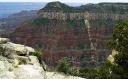
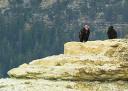
My friend B.J. made it to the north rim of the Grand Canyon yesterday and I’m anxious to hear where he went today. I may know before I finish this post. He has taken some great pics. Yesterday he actually got a shot of some Condors! Maybe that’s the advantage of going to the north rim. It’s more crowded at the south rim because the access to the views is easier and there are more places to look so consequently you have a lot more people around.
This is one of my favorite shots from the Grand Canyon
This is the shot of the condors.
Mindboggling Photosynth!
I saw a video yesterday (thanks for the heads up, Tony) that showed a gorgeous application called Photosynth. You can check it out at Microsoft Labs and as the news spreads there will be more videos and articles about it on the internet. If I understand it correctly – image resolution will no longer be a problem.
It creates a three-D image of other images – thousands of images taken by thousands of people. You can zoom in and out without losing quality.
Think back to a time when you have found a picture on the web that you wanted to use in a document. You saved it and then inserted it into your document but it was just a little thumbnail. You stretched it out to the size you wanted and it became ugly, blurry, and pixelated (or blocky) Not so with this – if you watch the demonstration you will see an entire book and the presenter will zoom in and the fonts will stay clear and smooth no matter what size you view.
The three-D part is where is gets confusing and exciting. You have this huge collection of photos (his demonstration used photos of Notre Dame) and all of the view might be slightly different and yet you can use this to get a 3D view of the site. You can also see from different perspectives and it looks like you can see the exact spot the photo was taken from.
Another aspect of this that is very cool is metadata. Metadata is everywhere and it simply means data about data. A non-computer example would be card catalogs in libraries. The card catalog is not the book but it tells you where the book can be found, who wrote it, and other information about the book. Metadata can describe a file or a web page. If you are looking at a web page and view the source code you will see some entries near the top that begin with meta – these usually contain information like keywords that help search engines find the website. Imagine that all these photos have been tagged with keywords and also contain metadata that gives you the time and date the photo was taken, gps coordinates for the exact spot where the photo was taken and much more. Imagine that all these photos coming together as a 3D view of the groups of them and the metadata for one becomes part of all.
I’m still trying to digest it. It gives a whole new meaning to research on the web. I think this will be huge and there will be more and better information as this becomes more known. My only saving grace is that in trying to find out more about it I ran across people much more knowledgeable than I am who were also asking tons of questions.
The implications for ecology, biology, and even astronomy are interesting. Of course we will needs some travelers willing to take their digital cameras to space for that. Imagine using this with microscopic photography, pictures taken from inside hurricanes and tornadoes, legal implications if this type of software is able to create images that can be admitted as evidence in a case.
What about the cultural implications of this and all the metadata that exists out there that leaves our “footprints”. If this application can zoom in on a building detail it can pick out the details of a face or hand in a crowd. We have historically worried about protecting our “privacy†on the internet but I wonder if as we become more aware of how transparent we are and how discoverable, will it cause us to live differently? You know the old saying about people who live in glass houses shouldn’t throw stones? They shouldn’t walk around naked with the lights on either. However – if you know the lights are going to be on – won’t you behave differently? Maybe this transparency isn’t all bad – if it means that we will strive to be perceived as better then we will act better and in the act, maybe become better. As our culture affects how we develop technology we more and more can see how technology affects culture. This is another one of those times when we can’t see ahead to what the long term repercussions will be but this is one that makes me hopeful.
Visually speaking, some thoughts were expressed in this quote “I used to live in Arizona, several years ago, and you’ll notice that the further away you get from a mountain, the more its figure stays the same regardless how far left you go, or how far right. I wonder how the software handles perspective, and distance on this magnitude.
Buildings, which have unnatural forms will look rather different depending on where you are. But mountains tend to retain their figure when you are further away, walking left or right.†http://channel9.msdn.com
Another person on this particular forum brought up the cameras that they use for intricate surgery and how they could use this technology to build 3D surgery so they could study it further.
Blaise Aguera y Arcas is the presenter and worked on the project before Microsoft purchased the companies that developed it. I hope you will watch the video because my explanation and description do not come close to the reality of this application. It truly has to be seen to be believed.
You can see a video here